DH-D-138BD
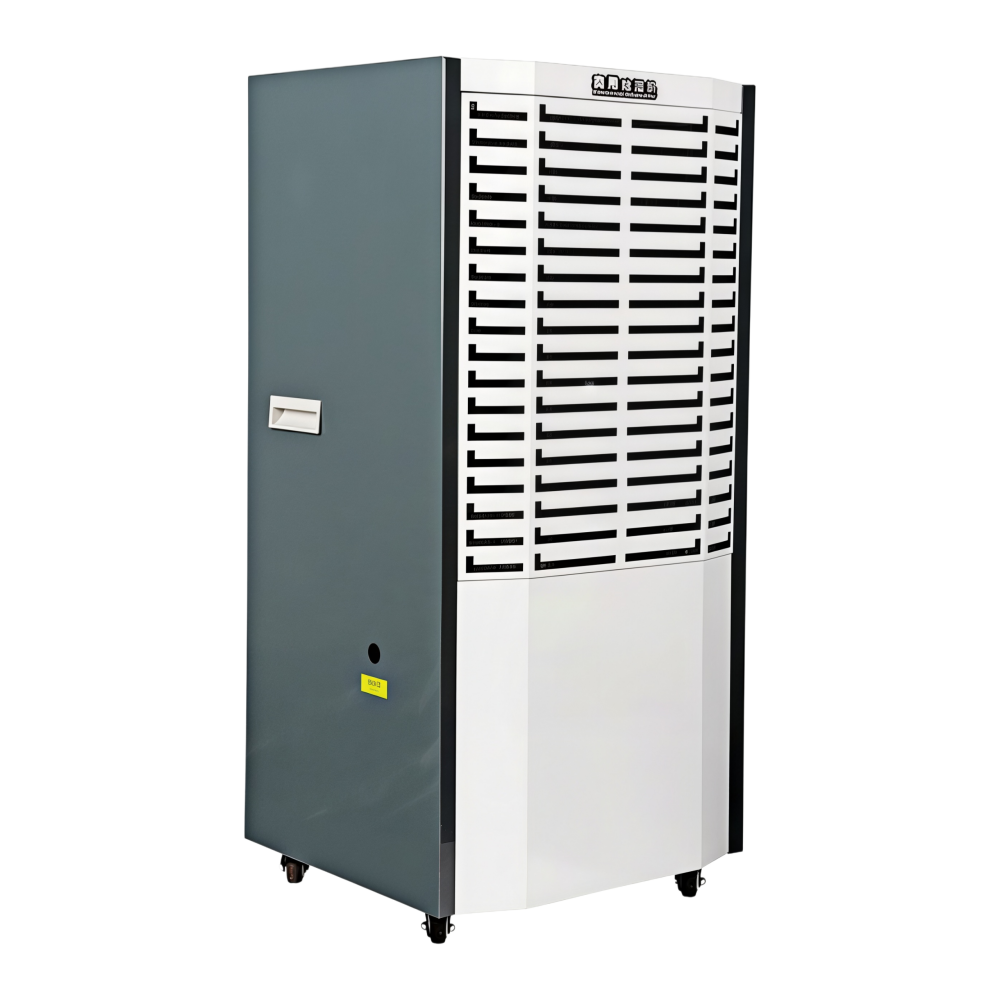
Portable commercial unit with tank and drainage outlet, 130–170 m².
Commercial and industrial dehumidifiers from Foshan, China — portable commercial units and vertical industrial units, for warehouses, factories, basements and garages.
Basements are humid by construction: below-grade walls, cool surfaces, and little air movement add up to damp air, condensation, and damage to everything stored down there. The manufacturer’s pages list basements in commercial buildings, basement utility areas, and flooded basements among the settings for these dehumidifiers, and this page gathers what those pages state for basement use — and states plainly what they do not.
The commercial feature rows describe moisture removal as protecting goods from mold and rust in humid climates, and the larger commercial page states that its unit prevents mold, mildew and condensation damage. The industrial feature rows describe protecting machinery and inventory from mold, rust and decay. Those are prevention claims: they describe keeping humidity down so that mold, rust and damage do not start. This page makes no remediation claim of any kind: no page on the manufacturer's site states that any model removes existing mold, treats a mold infestation, dries out a mold-damaged structure, or makes a mold-affected space safe, and none of those claims appears here. A basement that already has mold growth, visible colonies, or a health complaint attached to it needs remediation by a specialist, not a dehumidifier, and a buyer in that position should be told so in the inquiry rather than sold a unit on a prevention claim. Prevention and remediation are different jobs, and this site keeps them apart.
Basements rarely have a floor drain at the right height, and the drainage question decides the installation more often than the model does. The commercial pages describe drainage outlets for continuous operation, the smaller commercial model adds a removable water tank as the alternative, and the industrial pages describe integrated drainage systems for continuous disposal. A basement with a drain point — a floor drain, a sump, a sink, a pumped route to a higher drain — can run a drainage arrangement continuously, and the drain-hose terms in the keyword set point at exactly that arrangement. A basement with no drain point must rely on a tank, and only the DH-D-60BD is marked as having a tank in the comparison table, with no tank volume stated for any model, so the emptying interval cannot be calculated from any published figure. A flooded basement adds a further condition: standing water must be pumped out before any dehumidifier is the answer, because a dehumidifier dries air, not floors, and no page states a flood-recovery performance figure. The flooded-basement buyer should describe the water, the pumping, and the remaining dampness in the inquiry, in that order.
The area figures are the basement buyer's starting point, and they must be used as published: 80 to 140 square metres for the DH-D-60BD, 130 to 170 for the DH-D-138BD, 450 to 500 for the DH-D-12IH, and 600 to 800 for the DH-D-20IH. A basement's floor area is only part of the load: below-grade walls, the water table, the season, and what is stored in the space all add moisture, and a basement with visible damp patches or a history of seepage carries a heavier load than its floor area suggests. No source page states a basement-specific sizing rule, a wall-seepage allowance, or a dehumidification rate per square metre, and none is claimed here. The guide page sets out how the area and capacity figures are used together, keeping the litres-per-day and litres-per-hour languages apart. A buyer sizing for a basement should describe the floor area, the ceiling height, the wall condition, the water history, and what is stored, and let the supplier lay out the unit from those facts rather than from floor area alone.
This page presents no ranking, no review roundup, and no best-of list: the search terms behind it include best and top-rated phrases, but this site has no review evidence, no test laboratory, and no comparison testing of its own, and it does not pretend otherwise. What it presents is the manufacturer's own models, with the parameter blocks from the detail pages, the drainage arrangements the pages describe, and the prevention claims the pages make, each labelled with its source. The energy-efficiency wording in the search terms is answered the same way: the commercial pages describe energy-efficient operation as reducing electricity costs by 15 to 20 percent compared with standard dehumidifiers, and that is a company claim, quoted as such, not a measured efficiency figure for any model. A buyer who needs a measured energy figure should ask for it in the inquiry. The panel ranges — 30 to 80 percent relative humidity on the commercial models, 30 to 90 percent on the industrial models — are the control ranges the pages state, and the basement buyer should set the panel to the level the stored goods need, checking the result with a hygrometer rather than assuming the set-point is the achieved level.
Before ordering, confirm: the exact model and voltage for your site, the area and humidity load you need to cover, MOQ, lead time, and warranty. This page lists only what the source material verifies; anything not listed here is a question to ask, not a specification to assume.
Portable commercial unit with tank and drainage outlet, 130–170 m².
The tank model: removable tank or drainage outlet, 80–140 m².
Underground garage settings, inside the stated range.
Sizing, capacity language, and drainage.
Send your application, the area to be dried, and the voltage at the installation, and ask for a layout using the models on this page. Before payment, confirm MOQ, lead time, voltage, and warranty for your order.