DH-D-20IH
The largest model: 20 L/h, 6500 m³/h, 600–800 m².
Commercial and industrial dehumidifiers from Foshan, China — portable commercial units and vertical industrial units, for warehouses, factories, basements and garages.
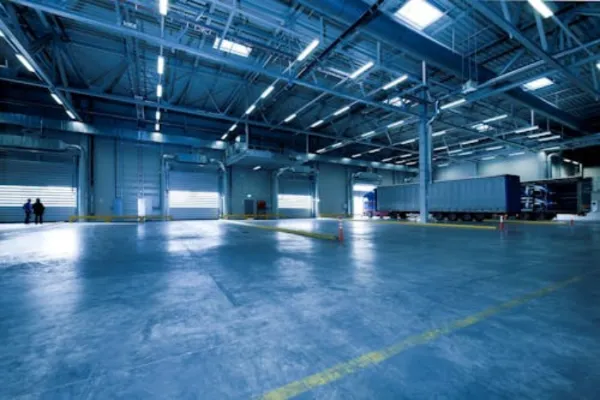
Warehouses store goods that suffer when humid air sits among them: cardboard softens, metal rusts, labels peel, and stored products take on moisture they cannot give back. The manufacturer’s pages list warehouse storage, storage rooms and industrial warehouses among the applications for both dehumidifier lines, and this page gathers what those pages state for warehouse and storage buildings.
The commercial pages list warehouse storage in Southeast Asia and storage rooms, and the larger commercial page adds storage rooms and data centers to its settings. The industrial pages list storage facilities and warehouses, and the larger industrial page lists industrial warehouses holding textiles, electronics and raw materials. Between the two lines, the warehouse buyer has a real choice to make, and the parameter blocks to make it with: the commercial models cover 80 to 170 square metres with air volumes of 500 and 750 cubic metres per hour, while the industrial models cover 450 to 800 square metres with air volumes of 3000 and 6500 cubic metres per hour. The warehouse's size decides which line fits, and the guide page sets out how the area figures are used. No source page states a warehouse air-change rate, a stacking height, or a goods-specific humidity target, and none is claimed here: matching a model to a warehouse is a project calculation using the building's size, height, openings, goods and heat sources.
A warehouse runs through the working day and often through the night, and a dehumidifier that stops to have its tank emptied stops doing its job on the same schedule. The industrial models answer that with integrated drainage systems for continuous disposal, and the commercial pages describe drainage outlets for continuous operation alongside the tank option on the smaller model. For a warehouse with a floor drain, a sink, or a pumped drainage route, the drainage arrangement is the natural fit, and the drainage blog sets out the two arrangements with the facts each page gives. For a warehouse with no drain point, the tank question must be asked explicitly: only the DH-D-60BD is marked as having a tank in the comparison table, and no tank volume is stated for any model, so the emptying interval cannot be calculated from any published figure. A buyer with no drain point should say so in the inquiry, because it changes which models fit the building.
Cold storage appears in the warehouse keyword set, and it needs a careful answer. Every detail page on this site states the same operating temperature range: 5 to 38 degrees Celsius. A cold store that runs below 5 degrees is outside that range, and no performance figure is published for operation below it. This site therefore makes no claim that any model on it serves a cold store below 5 degrees: a cold-storage buyer must state the actual storage temperature in the inquiry and get the matching answer in writing, rather than assuming a dehumidifier rated from 5 degrees will perform in a colder room. A storage room held at ordinary temperatures is inside the stated range, and the commercial and industrial models' area figures apply there as published. The distinction is the temperature, and the temperature must be stated, not assumed.
The commercial feature rows describe moisture removal as protecting goods from mold and rust in humid climates, and the industrial feature rows describe it as protecting machinery and inventory from mold, rust and decay. Those are the pages' claims, quoted as such, and they are the reason a warehouse buyer specifies a dehumidifier at all: the goods, not the building, are what humidity damages. The casing claims support the same point from the equipment side: corrosion-resistant casings described as withstanding humid, salty or dusty environments, with 8 or more years of use claimed on the commercial pages and 10 or more years on the industrial pages. Both casing claims are company claims, quoted as such. What the pages do not state is any goods-specific humidity target, any drying time, or any energy figure per unit of water removed, and none is claimed here: the inquiry should describe the goods, the packaging, and the damage humidity has already caused, so the answer can be matched to the actual loss being prevented.
Before ordering, confirm: the exact model and voltage for your site, the area and humidity load you need to cover, MOQ, lead time, and warranty. This page lists only what the source material verifies; anything not listed here is a question to ask, not a specification to assume.
The largest model: 20 L/h, 6500 m³/h, 600–800 m².
The tank model: removable tank or drainage outlet, 80–140 m².
Factory production lines and workshops.
Sizing, capacity language, and drainage.
Send your application, the area to be dried, and the voltage at the installation, and ask for a layout using the models on this page. Before payment, confirm MOQ, lead time, voltage, and warranty for your order.