Commercial dehumidifiers
The family page with the five-model comparison table.
Commercial and industrial dehumidifiers from Foshan, China — portable commercial units and vertical industrial units, for warehouses, factories, basements and garages.
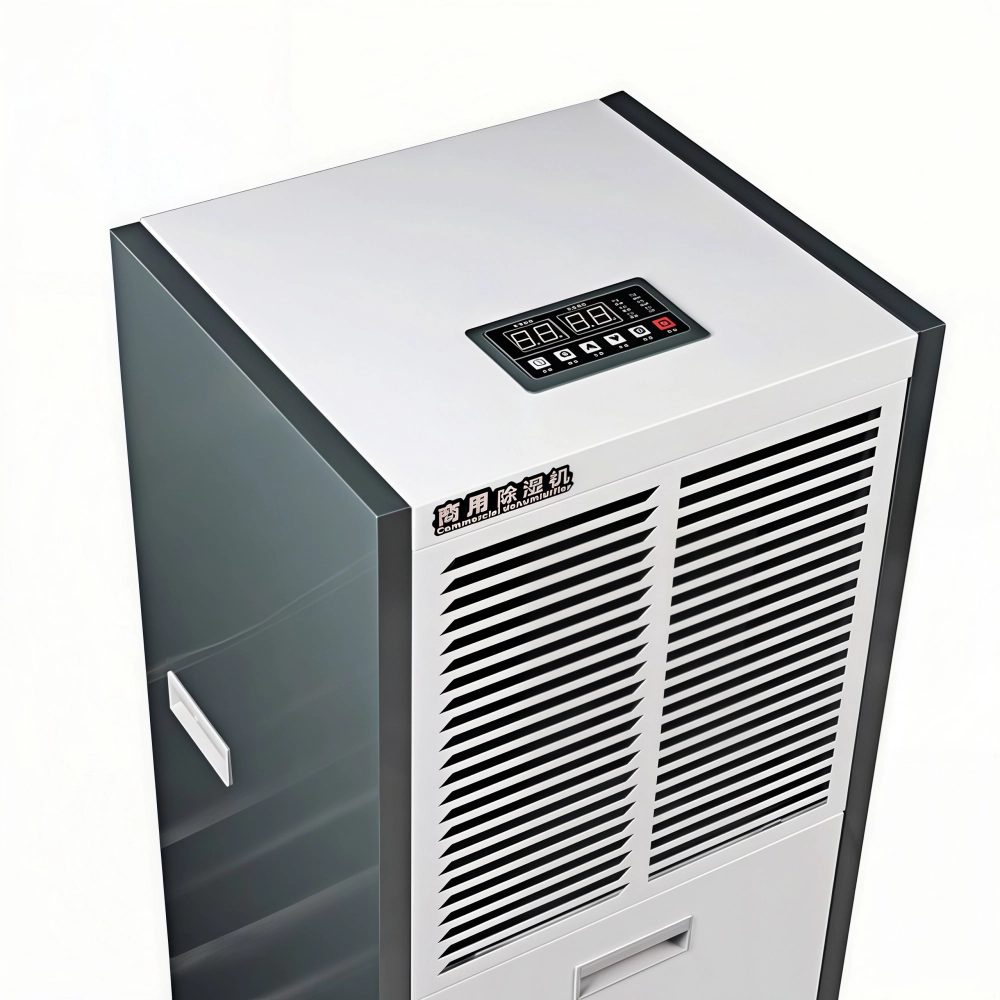
Choosing a dehumidifier is a sequence, not a single decision. Capacity language first, then area, then drainage, then controls — and at each step the manufacturer’s published tables, not catalogue adjectives, decide. This guide walks the sequence in order, using only figures the source pages publish, and it states plainly where the published evidence ends.
Capacity is published in two languages on this site, and the first step is to keep them apart. The commercial line names its models in litres per day — 60 to 90, 138, and a comparison range of 60 to 150 — while its parameter blocks state litres per hour: 1.49 for the DH-D-60BD and 2.3 for the DH-D-138BD. The industrial line names its models in litres per hour — 12 and 20 — while its page graphics add daily ranges of 240 to 328 and 440 to 528 litres per day. The product pages state no test conditions for either figure, so this guide never converts one into the other, and neither should any quotation: a daily figure and an hourly figure from the same page are two published statements, not two forms of one measurement, and a supplier who derives one from the other is inventing a test condition no page states. The blog on this site explains the point in full, with the arithmetic that must not be done. When comparing models, compare hourly figures with hourly figures and daily figures with daily figures, each labelled with its source, and ask any supplier who mixes the two to state which figure each number is.
Each detail page states an applicable area, and those areas are the sizing figures this guide uses: 80 to 140 square metres for the DH-D-60BD, 130 to 170 for the DH-D-138BD, 450 to 500 for the DH-D-12IH, and 600 to 800 for the DH-D-20IH. The table below adds square-foot equivalents as labelled arithmetic only — one square metre equals 10.7639 square feet, multiplied and rounded — because the search terms behind this page ask in square feet, and a labelled conversion is honest where an invented rating is not. The arithmetic does not change the figures: the square-metre values are the published ones, and the square-foot values are their equivalents by multiplication, nothing more. Area alone never sizes a dehumidifier: ceiling height, openings, moisture sources, stored goods, wall condition and the season all add load, and a space with a heavier load than its floor area suggests needs its load described in the inquiry. No source page states a sizing rule that adjusts area for load, and none is invented here.
| Model | Applicable area, as published | Square-foot equivalent (labelled arithmetic) |
|---|---|---|
| DH-D-60BD | 80–140㎡ | 861–1,507 sq ft |
| DH-D-138BD | 130–170㎡ | 1,399–1,830 sq ft |
| DH-D-12IH | 450–500㎡ | 4,844–5,382 sq ft |
| DH-D-20IH | 600–800㎡ | 6,458–8,611 sq ft |
A space between two models' areas — a 200 square metre workshop, a 300 square metre store — is not a reason to stretch either model: it is a reason to describe the space and its load in the inquiry and let the supplier lay out the unit. The comparison-table models without detail pages add further area figures — 100 to 200, 150 to 250 and 200 to 300 square metres for the DH-D-90BD1, DH-D-138BD1 and DH-D-150BD1 rows — and those figures are usable only with the summary-table attribution the commercial page gives them, never as detail-page specifications. A buyer choosing among them should ask for the full specification of the model being considered, because a summary-table row is not a parameter block.
Collected water has to go somewhere, and the installation decides the answer before the model does. If the installation has a drain point at a usable height — a floor drain, a sink, a sump, a pumped route — the drainage arrangement fits: the industrial models use integrated drainage systems for continuous disposal, the commercial pages describe drainage outlets for continuous operation, and the unit runs without emptying. If the installation has no drain point, the tank arrangement is the alternative, and only the DH-D-60BD is marked as having a tank, with a removable tank described on its detail page and no tank volume stated anywhere. The emptying interval therefore cannot be calculated from any published figure, and a buyer who needs to know it must ask. The drainage blog sets out both arrangements with the facts each page gives. The question to answer before ordering is not which arrangement is better in general, but which arrangement the installation allows, and the answer belongs in the inquiry with the drain points described.
The control panels are digital on every model, and the published ranges differ by line: 30 to 80 percent relative humidity on the commercial models, 30 to 90 percent on the industrial models. Those are control ranges — the settings the panel offers — not guarantees of achieved humidity at every point in the range, and not measurements of performance. The commercial pages describe an LED display, a humidity set-point and real-time monitoring; the industrial pages describe digital humidity regulation and, in the marketing blocks, a large screen with setting, timer, power-failure memory and failure self-detection. A buyer should set the panel to the level the stored goods or the process needs, and check the result with a separate hygrometer, because the set-point and the achieved level are different things and no page states the control accuracy. No page states a humidistat accuracy, a sensor type, or a control algorithm, and none is claimed here. The mold question belongs at this step too: the pages' claims are prevention claims — keeping humidity down so mold, rust and damage do not start — and no remediation claim is made anywhere on this site.
The commercial models run on 220 volt single-phase power at 50 hertz, and the industrial models on 380 volt three-phase power at 50 hertz, each stated on its own parameter block. Check the voltage at the installation, not the building's main supply: outbuildings, basements and garage positions do not always carry the same supply as the main board, and a unit ordered on the wrong supply cannot run. The operating temperature range is 5 to 38 degrees Celsius on every detail page, and a space colder or hotter than that is outside the published range, with no performance figure for operation beyond it. The package sizes — 443 by 424 by 728 millimetres for the DH-D-60BD, 556 by 495 by 1073 for the DH-D-138BD, 730 by 510 by 1750 for the DH-D-12IH, and 1080 by 560 by 1840 for the DH-D-20IH — are the figures to check against doorways, lifts and access routes. Fixing, ducting, drainage routing and control wiring are not described on any page, and they belong in the inquiry with the installation described.
The last step is not a selection step but a confirmation step, and it is the one buyers skip most. Confirm the exact model and its tabled figures from its own detail page, including the full model name where two models differ by one character. Confirm the capacity language of every figure in the quotation. Confirm the voltage, the area, the drainage arrangement, and the temperature range for the installation. Confirm MOQ, lead time and warranty, which no source page states. Confirm any hygiene or compliance requirement the site must meet, especially in food and pharmaceutical settings, where no page states a standard. And get the layout in writing — which unit, where, with what drainage — before any payment. A layout in writing can be checked model by model against the detail pages before anything is ordered; a verbal promise cannot. The mistakes this sequence prevents are the ordinary ones: converting capacity figures without test conditions, stretching an area figure to cover a heavier load, assuming a drain point that does not exist, reading a set-point as an achieved level, and ordering on a model name quoted without its suffix.
The table below compares the four detail-page models on the figures their own parameter blocks state. The table-only models are not in it: their figures stand on the commercial page with the attribution that keeps them honest, and a comparison that mixed them with detail-page figures without labelling the difference would mislead. Any figure used for ordering must be taken from the full table of the model being ordered, not from this summary.
| Model | Capacity, as stated | Power (rated / maximum) | Supply | Air volume | Area |
|---|---|---|---|---|---|
| DH-D-60BD | 1.49 L/h; page title 60–90 L/day | 960 W / 1100 W | 220V~50Hz | 500 m³/h | 80–140 m² |
| DH-D-138BD | 2.3 L/h; page title 138 L/day | 1250 W / 1750 W | 220V~50Hz | 750 m³/h | 130–170 m² |
| DH-D-12IH | 12 L/h; graphic 240~328 L/D | 4300 W / 4650 W | 380V 3N~50Hz | 3000 m³/h | 450–500 m² |
| DH-D-20IH | 20 L/h; graphic 440~528 L/D | 7600 W / 8400 W | 380V 3N~50Hz | 6500 m³/h | 600–800 m² |
Before ordering, confirm: the exact model and voltage for your site, the area and humidity load you need to cover, MOQ, lead time, and warranty. This page lists only what the source material verifies; anything not listed here is a question to ask, not a specification to assume.
The family page with the five-model comparison table.
The line page with the range-title rule.
Basement applications, drainage, and mold prevention.
Underground garage settings, inside the stated range.
Send your application, the area to be dried, and the voltage at the installation, and ask for a layout using the models on this page. Before payment, confirm MOQ, lead time, voltage, and warranty for your order.