DH-D-12IH
Vertical industrial unit: 12 L/h, 4300 W, 450–500 m².
Commercial and industrial dehumidifiers from Foshan, China — portable commercial units and vertical industrial units, for warehouses, factories, basements and garages.
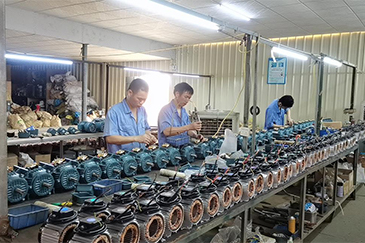
Factory air is working air: production lines, workshops and process areas generate heat and moisture through the working day, and humid air damages goods, machinery and product quality at the same time. The manufacturer’s pages list factory production areas and large-scale factory production lines among the applications for both dehumidifier lines, and this page gathers what those pages state for factory and workshop buildings.
The commercial pages name textile mills and electronics factories among the factory production areas, alongside warehouse storage, basements, food processing plants and pharmaceutical storage warehouses. The larger industrial page names large-scale factory production lines in automotive, electronics and machinery plants, and industrial warehouses holding textiles, electronics and raw materials. The smaller industrial page names factories, storage facilities and workshops generally. A factory buyer should read those lists as the trades the manufacturer has in mind, not as a guarantee for any particular process: a textile mill with steam, an electronics plant with static-sensitive assembly, and a food plant with washdown water have different air problems, and the process air must be described in the inquiry. No source page states a process-specific humidity target, a cleanroom class, or a drying rate for any named trade, and none is claimed here.
Food processing plants appear on the commercial pages, food and beverage processing facilities and pharmaceutical manufacturing plants appear on the larger industrial page, and pharmaceutical storage warehouses appear on the commercial pages. Those are the whole of the food and pharmaceutical evidence on this site, and the boundary matters: no page states a hygiene certification, a food-grade material, a washdown rating, or a pharmaceutical compliance standard for any model, and none is claimed here. A food or pharmaceutical buyer must state the applicable hygiene and compliance requirements in the inquiry and get the matching answer in writing, rather than reading the appearance of a trade name in an application list as a compliance claim. The application list says the manufacturer has those buildings in mind; it does not say any model meets a named standard, because no page states one.
The area figures are the factory buyer's main tool, and they must be used as published. The commercial models cover 80 to 140 and 130 to 170 square metres, and the industrial models cover 450 to 500 and 600 to 800 square metres, each figure stated on its own detail page. A workshop of 200 square metres sits between the commercial and industrial lines, and the answer is not to assume one line stretches: the humidity load, the ceiling height, the openings and the heat and moisture sources decide, and the inquiry should describe all of them. The air volumes tell the same story in different units: 500 and 750 cubic metres per hour on the commercial models, 3000 and 6500 on the industrial models. A production line with local steam or washdown moisture needs its moisture sources described, because area alone never sizes a dehumidifier for a process building. The guide page sets out how the area and capacity figures are used together, without converting one into the other.
A factory runs on a schedule, and a dehumidifier that stops for emptying stops on the same schedule. The industrial models use integrated drainage systems for continuous disposal, and the commercial pages describe drainage outlets for continuous operation alongside the tank option on the smaller model. For a production building, the drainage arrangement is usually the fit, provided a drain point exists, and the drainage blog sets out the arrangements with the facts each page gives. The steel housings and caster wheels on the industrial models, and the mobility wheels on the commercial models, are the pages' descriptions of units that must be moved or serviced in a working building. The 10-or-more-years casing claim on the industrial pages and the 8-or-more-years claim on the commercial pages are company claims, quoted as such. What no page states is a service interval, a filter life, or a maintenance schedule, and none is claimed here: those belong in the inquiry, with the production schedule described.
Before ordering, confirm: the exact model and voltage for your site, the area and humidity load you need to cover, MOQ, lead time, and warranty. This page lists only what the source material verifies; anything not listed here is a question to ask, not a specification to assume.
Vertical industrial unit: 12 L/h, 4300 W, 450–500 m².
Heavy-duty vertical unit: 20 L/h, 7600 W, 600–800 m².
Warehouse and storage applications.
Sizing, capacity language, and drainage.
Send your application, the area to be dried, and the voltage at the installation, and ask for a layout using the models on this page. Before payment, confirm MOQ, lead time, voltage, and warranty for your order.