DH-D-12IH and DH-D-20IH: Two Models Behind Two Range Titles
Two titles, two models
The industrial line is published as two pages with range titles: 6 to 12 litres per hour, and 15 to 40 litres per hour. A buyer reading those titles naturally assumes a range of models — a 6 litre unit, a 12 litre unit, a 15 litre unit, a 40 litre unit, and whatever sits between them. The pages do not support that reading. Each page tables exactly one model: the first tables the DH-D-12IH at 12 litres per hour, and the second tables the DH-D-20IH at 20 litres per hour. The untabled ends of the ranges have no parameter blocks, no feature tables, and no descriptions anywhere on the manufacturer's site that was found. This article explains the range-title rule, sets out the two tabled models side by side, and shows how the page graphics, the marketing blocks, and the applications fit around them — without inventing a single specification for a model that has no table.
The rule, stated once and kept
A range title is not a catalogue. It is the title of a page, and the page's parameter block is the specification. The 6 to 12 litre page's parameter block reads: model DH-D-12IH, capacity 12 litres per hour, supply 380 volt three-phase at 50 hertz, rated power 4300 watts, rated current 6.6 amps, maximum power 4650 watts, operating temperature range 5 to 38 degrees Celsius, circulating air volume 3000 cubic metres per hour, applicable area 450 to 500 square metres, package size 730 by 510 by 1750 millimetres. The 15 to 40 litre page's parameter block reads: model DH-D-20IH, capacity 20 litres per hour, supply 380 volt three-phase at 50 hertz, rated power 7600 watts, rated current 11.6 amps, maximum power 8400 watts, the same temperature range, air volume 6500 cubic metres per hour, applicable area 600 to 800 square metres, package size 1080 by 560 by 1840 millimetres. Those two blocks are the industrial line's specifications, complete. The 6, 15 and 40 litre ends have no blocks, and this article gives them none. A buyer who needs a figure at one of those ends should ask whether a model exists there, with its own parameter block, rather than reading the title as a promise. An older image title that attached a lower figure to the 12IH model is not used anywhere on this site: an image title is not a parameter value, and it is never quoted as a specification.
The graphics, and their daily ranges
Each industrial page carries a specification graphic whose wording is recorded on the model pages as the graphic's wording, and the two graphics are worth comparing because they agree on settings and differ on figures. Both name underground garages, shopping malls, bath centers, drying rooms and home dehumidification, and both describe the unit as a high-power industrial and commercial dehumidifier. The first states a daily range of 240 to 328 litres per day with an applicable area of 450 to 500 square metres; the second states 440 to 528 litres per day with 600 to 800 square metres. The areas agree with the parameter blocks. The daily ranges are the graphics' claims, quoted with that label on the model pages and here, and they are not derived from the hourly parameter values — not by this site, and not by any supplier quoting this site. The settings the graphics name are quoted with the same care: they are the graphics' wording, kept inside the stated temperature range of 5 to 38 degrees Celsius, and the garage page treats the underground-garage name with exactly that boundary. A graphic is not a parameter block, and a setting named in a graphic is not a specification for that setting.
The two models, side by side
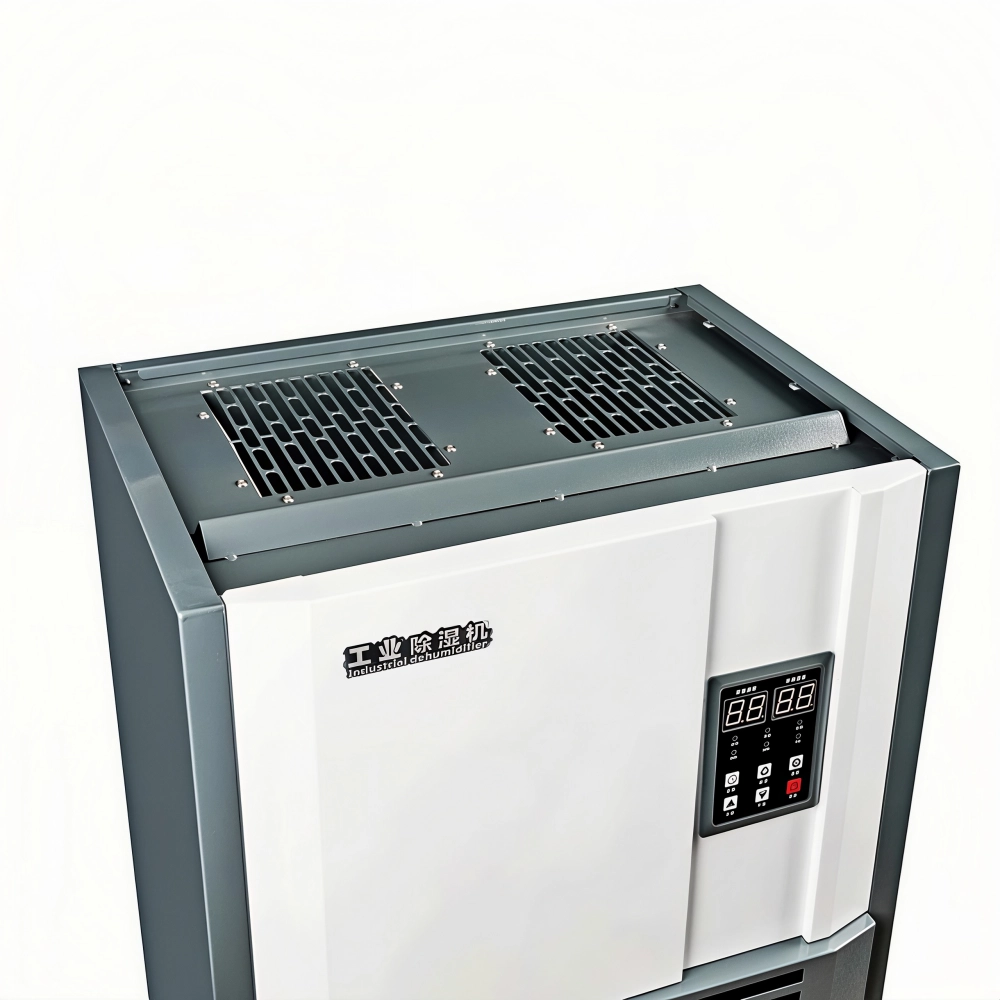
Set the two parameter blocks side by side and the line's shape appears. Capacity doubles, near enough: 12 against 20 litres per hour. Power rises faster than capacity: 4300 against 7600 watts rated, 4650 against 8400 maximum, with rated currents of 6.6 and 11.6 amps on the same 380 volt three-phase supply. Air volume more than doubles: 3000 against 6500 cubic metres per hour. Applicable area rises by a smaller step: 450 to 500 against 600 to 800 square metres. Package size grows in every dimension: 730 by 510 by 1750 millimetres against 1080 by 560 by 1840. The two models share the temperature range, the supply, the vertical form, the digital control panel, the steel housing, the front intake, the top-mounted exhaust, the casters, and the drainage-only arrangement. They differ in every figure that sizes them. A buyer choosing between them is therefore choosing on figures, not on features: the features are shared, the figures are not, and the figures must be taken from the parameter block of the model being ordered, not from the range title of the page it sits on. The guide page sets out how the area and capacity figures are used together, and the industrial family page states the range-title rule in full.
The marketing blocks, and their status
Both industrial pages carry marketing blocks describing nine upgraded functions and construction details, and both blocks are treated the same way on this site: company marketing copy, quoted with that attribution, never as specifications. The lists name protection circuits, intelligent frosting, self-diagnosis, mute setting, automatic protection, temperature control, bi-directional timing, intelligent memory and intelligent recognition; a thickened sheet-metal body; copper-tube condensers and evaporators; a powerful airflow metal turbine waterproof motor; an enclosed copper-wound movement; power and intelligent control; a waterproof, fireproof and short-circuit-proof control-box encapsulation; automatic frosting; a large high-definition screen with setting, timer, power-failure memory and failure self-detection; and direct drainage with an external water pipe. The lists are long, and their length is not evidence: no function in either list carries a figure, a test result, or a standard, and none is presented here as a measured property of either model. A buyer who values a named function — self-diagnosis, power-failure memory, frost control — should ask what it does on the quoted model, in the actual installation, rather than assuming the marketing list is a specification. The lists are identical on both pages, which tells the buyer something useful: they describe the line, not the model, and they do not distinguish the DH-D-12IH from the DH-D-20IH on any point.
Applications, and the boundary of the evidence
The smaller industrial page lists factories, storage facilities, workshops and humid tropical climates across Southeast Asia, and its graphic names underground garages, shopping malls, bath centers, drying rooms and home dehumidification. The larger industrial page lists large-scale factory production lines in automotive, electronics and machinery plants, industrial warehouses holding textiles, electronics and raw materials, basement utility areas, food and beverage processing facilities, and pharmaceutical manufacturing plants. Those lists are the whole of the industrial application evidence, and the boundary is visible: no page states a hygiene certification, a food-grade material, a cleanroom class, or a compliance standard for any model, and none is claimed here. A food or pharmaceutical buyer must state the applicable requirements in the inquiry. A garage buyer must state the lowest winter temperature, because the stated range stops at 5 degrees. A basement buyer must describe the water history, because the basement page's prevention claims are not remediation claims. The applications describe where the manufacturer has these models in mind; the parameter blocks describe what the models are. Both are needed, and neither substitutes for the other.
Ordering from a range title
The practical lesson of the range-title rule is a habit: always order from the parameter block, never from the title. Quote the full model name. Quote the capacity with its unit and its source. Quote the power, the supply, the air volume, the area and the package size from the same block. Ask for the graphic's daily range as the graphic's range, if a daily figure is needed. Ask whether a model exists at an untabled range end, with its own block, if the need sits there. And confirm the installation facts the blocks do not supply: the voltage at the installation, the drain points, the temperature range, and the commercial terms no page states. A buyer who follows that habit cannot be sold a model that does not exist, because the habit requires a parameter block before a model can be ordered. The range titles will keep reading 6 to 12 and 15 to 40. The specifications will keep reading DH-D-12IH and DH-D-20IH. Keep the two apart, and the line is easy to buy from. Confuse them, and it is easy to buy wrong.
Facts used here come from the manufacturer's own product pages for the DH-D-12IH and DH-D-20IH industrial dehumidifiers. No figure appears here that those pages do not state, and no specification is given for any untabled model. Where the pages are silent — the range ends, the test conditions, the compliance standards — this article is silent too, and turns the silence into a question for the inquiry.
Request a dehumidifier layout
Send your application, the area to be dried, and the voltage at the installation, and ask for a layout using the models on this page. Before payment, confirm MOQ, lead time, voltage, and warranty for your order.