Litres per Day vs Litres per Hour: Dehumidifier Capacity Explained
Two numbers on one page
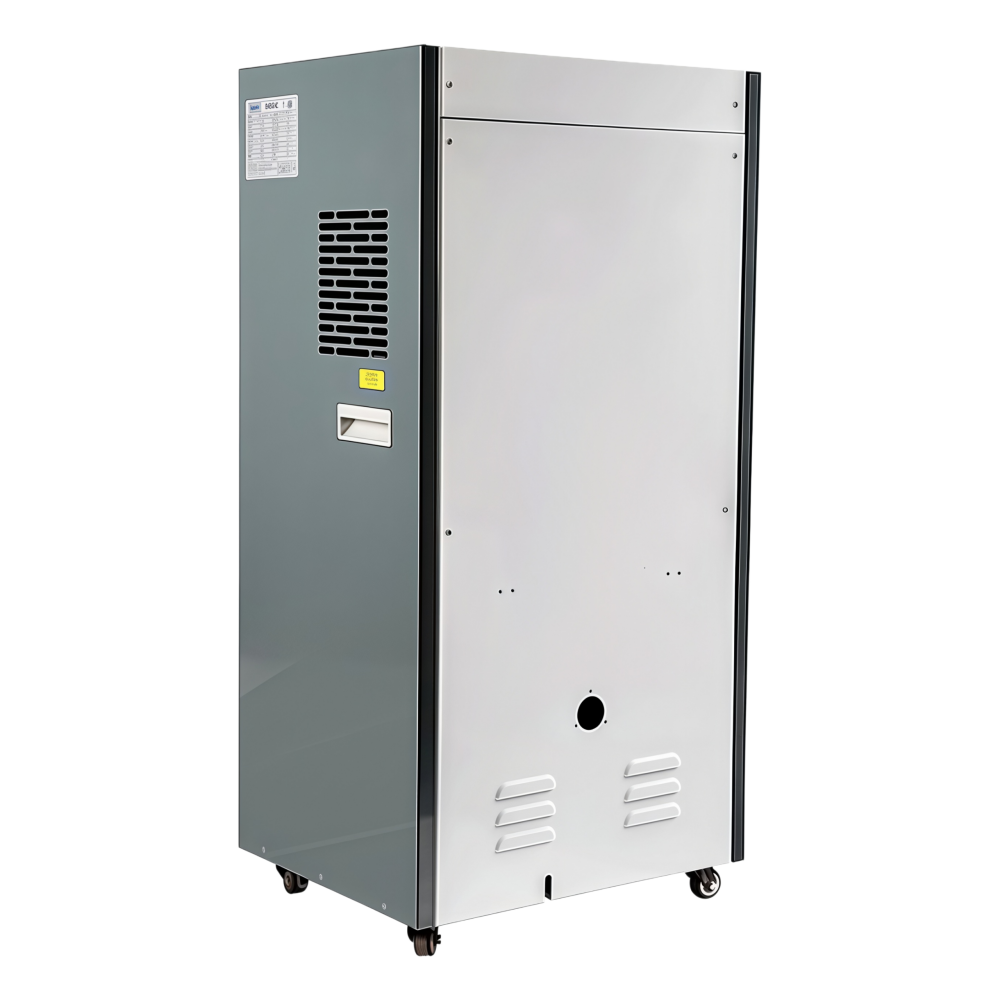
Open the DH-D-60BD detail page and two capacity numbers stare back at you. The page title reads 60 to 90 litres per day. The parameter block reads 1.49 litres per hour. Open the DH-D-138BD page and the same pair appears: 138 litres per day in the title, 2.3 litres per hour in the parameter block. Both numbers are printed on the same page, by the same manufacturer, for the same model — and this site never turns one into the other. That refusal is not caution for its own sake. It is the only honest reading of the evidence, and this article explains why, what the numbers are, and how a buyer should use them.
What each number is, and where it stands
The daily figure is the page's naming and feature figure. It appears in the page title — 60 to 90 litres per day, 138 litres per day — and in the first row of the feature table, which states moisture removal of up to the daily figure, protecting goods from mold and rust in humid climates. It is the figure the product is sold by, and the figure a buyer remembers. The hourly figure is the parameter-block value. It appears in the parameter block's dehumidification capacity row, alongside the power supply, the rated and maximum power, the rated current, the operating temperature range, the air volume, the applicable area and the package size. It is the figure the specification table uses, and the figure an engineer checks. The two figures live in different parts of the page, serve different purposes, and are published without any statement connecting them. No test conditions — no temperature, no relative humidity, no test duration, no standard — are stated on either page for either figure. That absence is the whole story, and it is why the two figures must be kept in their own places.
Why no conversion is legitimate
Converting an hourly rate into a daily total requires one assumption: that the rate holds, unchanged, for the whole period. Dehumidification does not work that way, and the pages do not claim it does. A dehumidifier's removal rate depends on the air it takes in — its temperature and its humidity — and both change through the day, through the season, and as the room itself dries. A rate measured at one temperature and humidity is not a rate that holds at every temperature and humidity, and a daily total is not an hourly rate multiplied by the hours in a day unless the conditions are stated and held. The pages state no conditions, so the multiplication has no basis. A supplier who performs it is not calculating; the supplier is assuming a test condition no page states, and presenting the result as if the page had stated it. The industrial pages make the contrast visible: their graphics state daily ranges — 240 to 328 litres per day for the 12IH page, 440 to 528 for the 20IH page — as the graphics' own claims, separate from the parameter-block hourly values of 12 and 20 litres per hour. The graphics' ranges are quoted on this site as the graphics' claims, labelled as such, and they are not derived from the hourly figures either, even where the arithmetic happens to be consistent. Consistency is not evidence of a shared test condition, and this site does not treat it as one.
The comparison table, and the third language
The commercial comparison table adds a third way of stating capacity, and it must be handled with the same care. Its capacity row states litres per day for all five models: 60, 60, 90, 138 and 150. That row is a summary-table row, not a parameter block, and it is reproduced on the commercial family page with the attribution that status requires. For the DH-D-60BD, the table's 60 litre figure is usable with that attribution, alongside the detail page's figures; the table's power figures for that model are superseded by the detail page and are not used. For the four table-only models, the daily figures are the only capacity figures published, and they are never presented as detail-page values. A buyer comparing the DH-D-60BD against the DH-D-90BD1 is therefore comparing a detail-page model against a summary-table row, and the comparison must say so. The capacity language is the same — litres per day — but the evidence level is different, and the evidence level is part of the specification. A comparison that hides it is not a comparison; it is a list.
What to do with the two numbers
Use each number for the job its place gives it. Use the daily figure to understand what the product is sold as, and to match the page title against the quotation: if a supplier quotes a 60 to 90 litre unit, the quotation should name the DH-D-60BD and its detail page, and the daily figure should appear as the page's title figure, not as a derived total. Use the hourly figure to check the specification: if a supplier quotes a parameter block, the capacity row should read 1.49 litres per hour for the DH-D-60BD and 2.3 for the DH-D-138BD, with the power, current, temperature range, air volume, area and package size beside it, as the detail pages print them. Ask any supplier who quotes only one figure to state the other, with its source, in the same writing. And if a supplier quotes a daily figure derived from an hourly one — or an hourly figure derived from a daily one — ask for the test conditions behind the derivation. If none are stated, the derivation has no basis, and the quotation should be reissued with the figures as published. That question costs nothing, and it separates a supplier quoting the manufacturer's pages from a supplier quoting their own arithmetic.
The area figures, and why they are not a conversion either
The same discipline applies to the applicable-area figures, which buyers sometimes treat as a second conversion route: area into capacity, or capacity into area. The detail pages state areas of 80 to 140 square metres for the DH-D-60BD, 130 to 170 for the DH-D-138BD, 450 to 500 for the DH-D-12IH, and 600 to 800 for the DH-D-20IH. Those are published figures, usable as published. They are not derived from the capacity figures on any page, and no page states a rate per square metre, a sizing formula, or a load allowance that would let a buyer derive one from the other. The guide page adds square-foot equivalents as labelled arithmetic — multiplication by 10.7639, rounded — and labels them as arithmetic, because a unit conversion is not a performance claim. But area into capacity is a performance claim, and it is not made anywhere on this site. A space with a heavier humidity load than its floor area suggests needs its load described in the inquiry, not its area multiplied by an invented factor.
A quotation checklist
Before accepting any quotation for a commercial or industrial dehumidifier, check five things. First, the full model name, including the suffix or its absence, because the DH-D-138BD and the DH-D-138BD1 are different models with different figures. Second, the capacity figure with its unit and its source: daily title figure or hourly parameter value, labelled as such, never converted. Third, the power figures from the detail page for detail-page models, not from the summary table where the two disagree. Fourth, the applicable area from the same detail page, used as published, with the space and its load described alongside it. Fifth, the installation facts the parameter blocks do not supply: the voltage at the installation, the drain points, the temperature range, and the commercial terms no page states. A quotation that passes all five can be compared against another. A quotation that fails any of them is not yet a quotation; it is a draft waiting for the missing facts.
Facts used here come from the manufacturer's own product pages for the commercial and industrial dehumidifiers. No figure appears here that those pages do not state, and no figure on one page is converted into a figure on another. Where the pages are silent — test conditions, derived totals, sizing formulas — this article is silent too, and says so.
Request a dehumidifier layout
Send your application, the area to be dried, and the voltage at the installation, and ask for a layout using the models on this page. Before payment, confirm MOQ, lead time, voltage, and warranty for your order.