Tank or Drain Hose: How Collected Water Is Handled
Water has to go somewhere
Take a litre of water out of the air and it has to go somewhere — as a litre of water. Obvious, and the most overlooked fact in dehumidifier buying. Capacity, power, area: those get compared. The water question waits until the unit arrives, and then the answer is a tank nobody empties, or a drain point that does not exist. Two answers appear on the manufacturer's pages, a removable tank and a drainage outlet, and they suit different installations. What each page actually states, which models offer which arrangement, and how the installation decides: that is what follows.
The tank arrangement, as the pages state it
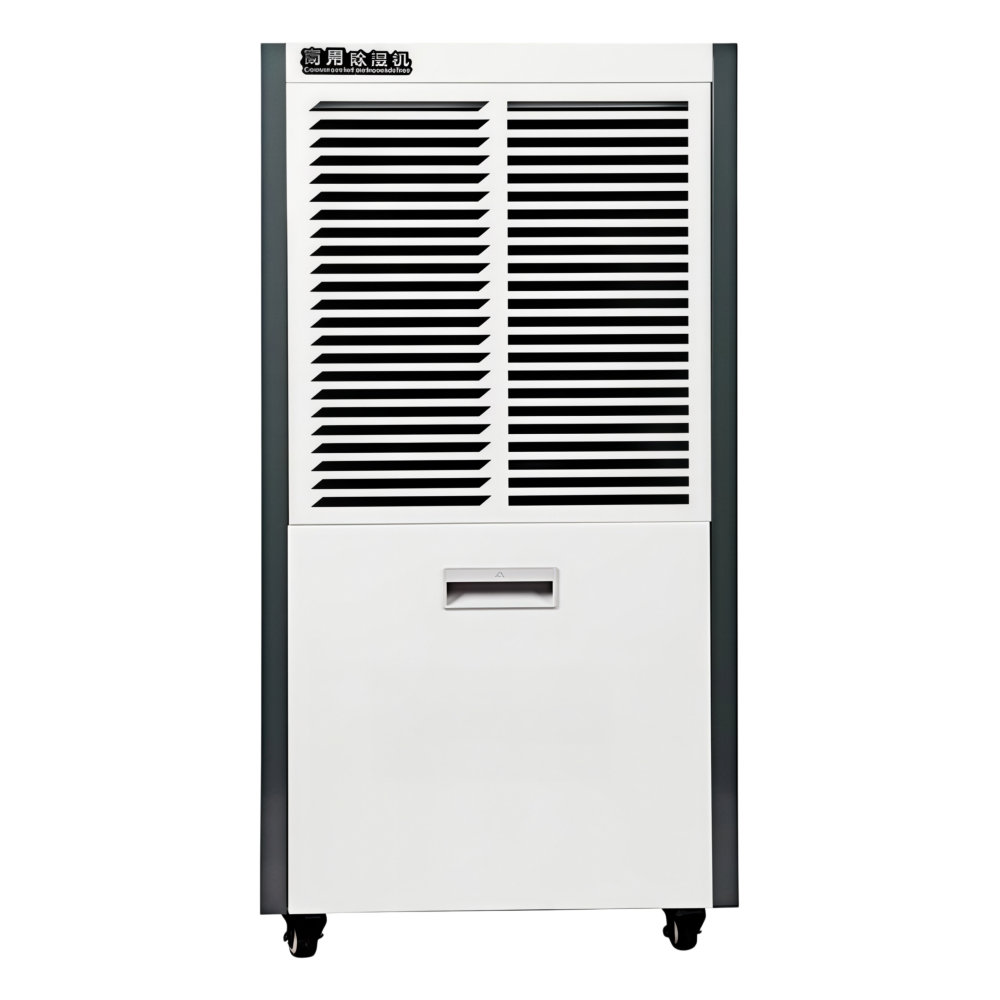
Only the commercial line has a tank arrangement at all. On the DH-D-60BD detail page: a removable water tank or a drainage outlet for continuous operation. The commercial comparison table marks only the DH-D-60BD as having a tank; the other four rows are marked as having none. The DH-D-138BD detail page describes a high-capacity water tank with a drainage outlet — and no integrated-drawer feature row. That is the whole of the tank evidence, all of it. For volume, the pages say nothing: no tank volume in litres for any model, not the removable tank, not the high-capacity tank, not the collection drawer. So this site states no tank volume, and no emptying interval can be calculated from any published figure. Someone empties a tank, on a schedule the water production sets. That schedule cannot be known until the unit runs in the actual space. Need the interval? Ask, with the space and its humidity load described — rather than assuming a figure no page states. One more distinction, the drawer: the integrated water collection drawer is a feature row on the DH-D-60BD page only. It is not transferred to any other model on this site.
The drainage arrangement, as the pages state it
Both lines have the drainage arrangement. Drainage outlets for continuous operation, on the commercial pages. The DH-D-60BD page pairs its tank with a drainage outlet. Integrated drainage systems for continuous disposal, on the industrial pages, with a direct drainage mode and an external water pipe named in the marketing blocks. The operative word is continuous: no emptying, provided the drain point exists and the route falls or pumps correctly. What the pages do not describe: the drain hose, its diameter, its routing, its fall, any pump. No drain-hose specification appears on any detail page, and none is claimed here. What they do establish is the arrangement itself — collected water leaves through an outlet or a drainage system, continuously, with no tank cycle. Floor drain, sink, sump, pumped route to a higher drain: a buyer with one of those has the installation a drainage arrangement needs. A buyer with none of them has the installation a tank arrangement needs. Then the tank question must be asked explicitly. Only one model is marked as having a tank, and no volume is published for it.
Which models offer which arrangement
Model by model, the answer is short enough to state completely. DH-D-60BD: both — a removable water tank or a drainage outlet, with an integrated water collection drawer — and the comparison table marks it as the only tank model. DH-D-138BD: a high-capacity water tank with a drainage outlet, without a drawer row. DH-D-12IH and DH-D-20IH: drainage only, integrated drainage systems for continuous disposal, no tank mentioned on either industrial page. The four table-only commercial models — DH-D-60BD1, DH-D-90BD1, DH-D-138BD1 and DH-D-150BD1 — carry the table's no-tank mark, with that attribution, and nothing beyond the table mark describes their drainage arrangements. None is claimed for them. On the water question alone, then, the map is clear: tank or drainage on the smaller commercial model; tank with drainage on the larger commercial model; drainage only on the industrial models; a table mark only for the four table-only models. Anything beyond that map: ask for it. Do not assume it.
The installation decides, not the catalogue
Not the catalogue — the installation decides. And the installation facts are few. Where the drain points are. What height they sit at. How far the unit stands from them. Whether the route falls or needs a pump. Sump in the basement, floor drain in the warehouse, process drain in the factory, gully in the garage: each of those has the drain point a drainage arrangement needs. Describe it in the inquiry — heights, distances — so the drainage route can be confirmed. No drain point in the basement, no drain permitted in a rented space, an installation that must keep moving: each of those needs the tank question answered, and the emptying schedule discussed honestly. A tank that fills overnight and stops the unit at midnight is a unit not dehumidifying when the space needs it most. No drain-hose diameter, no pump specification, no fall requirement: the pages state none of them. Routing details belong in the inquiry, with the installation described — not in an assumption drawn from the arrangement's name. A supplier confirming the drainage route in writing, outlet, route, fall or pump, drain point, has answered the water question. A supplier confirming only the model has not.
Continuous operation, and what it means
Continuous operation — the pages' phrase for the drainage side — deserves a precise reading. The unit runs without stopping for a tank to be emptied. Water leaves as it is collected; the unit keeps drying. That is all it means. Not: the unit runs without attention of any kind. Filters need cleaning, and the commercial pages describe easy-to-clean air filters. The drainage route needs checking. A blocked outlet stops a drainage unit as surely as a full tank stops a tank unit. No filter-cleaning interval, no drainage-inspection interval, no service schedule: the pages state none, and none is claimed here. Those belong in the inquiry, with the installation and its dust and dirt load described. An arrangement, not a maintenance-free promise — read it as the latter and the first blocked outlet comes as a surprise. Same precision on the tank side. A tank arrangement is not fit-and-forget either. The emptying schedule is part of the unit's operating cost, in staff time if not in money.
What to ask, before ordering
Five questions settle the water arrangement. What drain points exist at the installation, at what height, how far from the unit's position. Whether the route falls naturally or needs a pump — and who supplies the pump, if one is needed. Which arrangement the quoted model offers, tank, drainage, or both, quoted from the model's own page and not from another model's description. For a tank arrangement, the tank volume and the expected emptying interval in the actual space, asked explicitly: no volume is published. The filter-cleaning and drainage-checking routine the supplier recommends for the installation, asked explicitly: no interval is published. All five answered, and the quotation has answered the water question. None of them answered, and the most practical question in dehumidifier buying has been left to chance. Chance is how water ends up on the floor.
Facts used here come from the manufacturer's own product pages for the commercial and industrial dehumidifiers. No tank volume, drain-hose specification, pump specification, or emptying interval appears here that those pages do not state — and where the pages are silent, this article says so, and turns the silence into a question for the inquiry.
Request a dehumidifier layout
Send your application, the area to be dried, and the voltage at the installation, and ask for a layout using the models on this page. Before payment, confirm MOQ, lead time, voltage, and warranty for your order.